
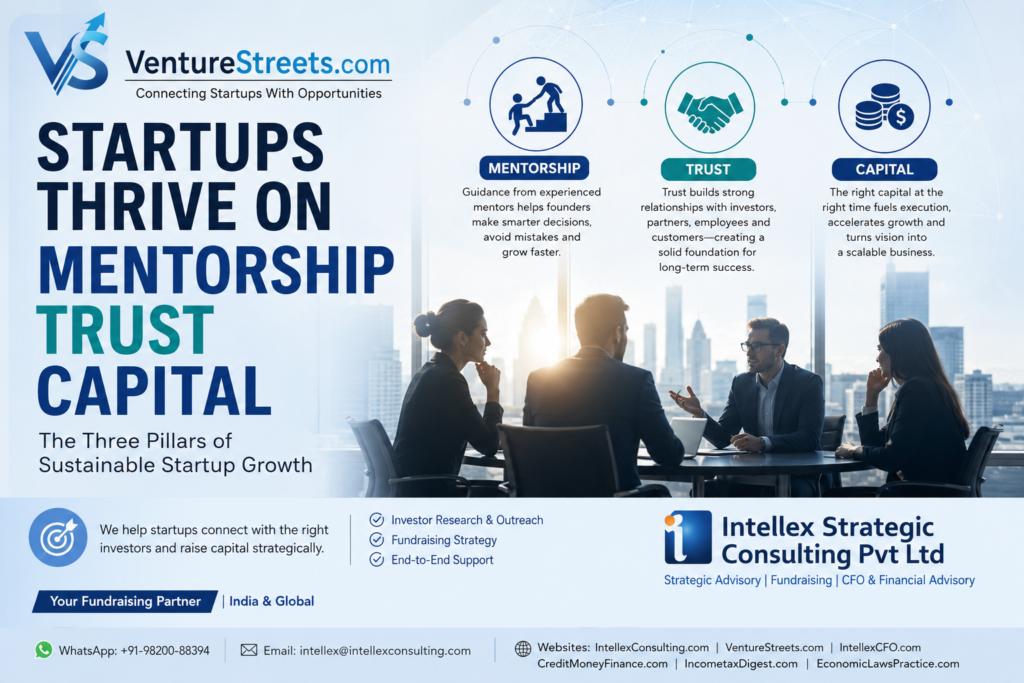
Startups Thrive on Mentorship, Trust and Capital: The Three Pillars Behind Successful Startup Growth
Startups Thrive on Mentorship, Trust and Capital: The Three Pillars of Sustainable Startup Growth and Successful Fundraising.
Discover why mentorship, trust and capital are critical to startup success. Learn how founders can build strong investor relationships, access funding and scale their businesses sustainably.
Startups Thrive on Mentorship, Trust and Capital
Building a startup is often described as a journey from idea to execution, execution to product-market fit, and product-market fit to scale.
But behind almost every successful startup is something more fundamental: the right people, the right relationships and the right capital at the right time.
A promising idea alone does not guarantee success. Even a highly talented founder can struggle without experienced guidance, trustworthy relationships and sufficient financial resources.
This is why three elements have become increasingly important in today’s startup ecosystem:
Mentorship. Trust. Capital.
These three pillars work together.
Mentorship provides direction.
Trust creates relationships.
Capital provides the fuel for execution.
When these elements come together, startups have a much stronger foundation for sustainable growth.
1. Mentorship: Experience Can Shorten the Learning Curve
One of the biggest challenges faced by startup founders is that they are frequently solving problems they have never encountered before.
A founder may be excellent at technology but have limited experience in:
- fundraising
- sales
- financial management
- hiring
- corporate governance
- investor relations
- regulatory compliance
- international expansion
- mergers and acquisitions
- building a management team
This is where experienced mentors can make a significant difference.
A good mentor does not necessarily tell the founder what to do. Instead, a mentor helps the founder ask better questions and avoid unnecessary mistakes.
The value of experienced mentorship
An experienced mentor can help a startup:
- evaluate its business model
- identify weaknesses in its strategy
- improve its pitch
- prepare for investor meetings
- understand valuation expectations
- develop a go-to-market strategy
- recruit key executives
- establish financial discipline
- negotiate with investors
- prepare for expansion
The most valuable mentorship is often based on real-world experience rather than theoretical knowledge.
A founder who learns from someone who has already built, scaled, funded or exited a company can potentially avoid years of trial and error.
2. Trust: The Foundation of Startup Relationships
Money is important in business, but trust is often more important when relationships are being built.
Startup ecosystems depend heavily on relationships between founders, investors, mentors, advisors, employees, customers and strategic partners.
Investors are not merely investing in a business plan.
They are also investing in:
- the founders
- the management team
- the company’s integrity
- the quality of information provided
- the founder’s ability to execute
- the founder’s willingness to communicate difficult realities
This makes trust a critical component of fundraising.
Why investors value transparency
No startup has a perfect journey.
There may be:
- missed targets
- delayed product launches
- higher-than-expected costs
- customer losses
- hiring challenges
- regulatory issues
- changing market conditions
Experienced investors generally understand that startups face uncertainty.
What damages relationships is not necessarily bad news—it is surprising investors with bad news that could have been communicated earlier.
A founder who communicates honestly during difficult periods can often preserve investor confidence.
Trust is built through consistency
Trust is not created during a single investor meeting.
It develops through repeated behaviour.
For example:
Promise → Deliver → Communicate → Report → Repeat
Over time, this creates credibility.
A startup founder who consistently provides accurate information, meets commitments and communicates transparently can build a strong reputation within the investment ecosystem.
And reputation can become a significant asset when the company raises future rounds.
3. Capital: The Fuel That Converts Vision Into Execution
Mentorship and relationships can provide direction, but startups also require financial resources.
Capital allows a company to convert its plans into measurable execution.
Depending on the stage of the business, funding may be required for:
- product development
- technology infrastructure
- research and development
- employee salaries
- marketing
- sales
- inventory
- manufacturing
- regulatory approvals
- working capital
- international expansion
- acquisitions
However, raising money should not be the ultimate objective of a startup.
The objective should be to raise the right amount of capital from the right investors at the right stage and deploy it effectively.
4. Not All Capital Is the Same
One of the common mistakes founders make is focusing only on the amount of money an investor is willing to provide.
For example, a founder may think:
“Investor A is offering ₹10 crore, while Investor B is offering ₹7 crore. Therefore, Investor A is better.”
Not necessarily.
The right investor may bring much more than money.
An investor can potentially provide:
- industry connections
- strategic partnerships
- international market access
- recruitment assistance
- future fundraising support
- corporate relationships
- acquisition opportunities
- governance expertise
- credibility with future investors
Therefore, founders should evaluate strategic value alongside financial value.
5. The Right Investor Can Become a Strategic Partner
A good investor relationship should ideally extend beyond the transaction.
The best investor-founder relationships often resemble a partnership.
The investor may challenge the founder’s assumptions, introduce customers, help recruit senior executives and assist with future fundraising.
At the same time, the founder must remain responsible for operating the company.
This distinction is important.
Investors should provide value without replacing management.
Founders need capital and guidance, but they also need sufficient autonomy to execute their vision.
The ideal relationship is therefore built around:
Capital + Expertise + Network + Trust + Strategic Alignment
6. Mentorship and Capital Work Better Together
Imagine two startups with similar technology, similar market opportunities and equally talented founders.
Startup A
The company raises capital but receives little strategic guidance.
Startup B
The company raises capital from investors who also provide industry expertise, connections and strategic mentorship.
Over time, Startup B may have an advantage.
This is because capital can accelerate growth, but knowledge can improve the quality of that growth.
Money can help a company hire 20 people.
Mentorship can help determine which 20 people should be hired.
Capital can help launch a product.
Experience can help determine which market should be entered first.
Capital can fund international expansion.
Strategic guidance can help determine whether international expansion is actually appropriate at that stage.
7. What Startups Should Do Before Approaching Investors
Fundraising should ideally begin long before the first investor meeting.
Founders should prepare several critical areas.
1. Build a clear business model
Investors need to understand:
- What problem does the startup solve?
- Who is the customer?
- Why is the problem important?
- How does the company make money?
- How large is the potential market?
2. Demonstrate traction
Depending on the business, traction may include:
- revenue
- customer growth
- recurring revenue
- user growth
- retention
- partnerships
- distribution
- technology adoption
- unit economics
3. Prepare financial projections
Investors will generally want to understand how the business expects to use capital and how it plans to achieve future growth.
4. Create a strong investor presentation
A good pitch deck should communicate the opportunity clearly without overwhelming investors with unnecessary information.
5. Understand the fundraising requirement
Founders should have a clear answer to:
How much are you raising and what will the money accomplish?
Simply saying, “We need ₹10 crore to grow” is insufficient.
A stronger explanation would connect capital to specific milestones.
For example:
₹10 crore → product development → team expansion → customer acquisition → revenue milestone → next funding round
8. Investors Also Look Beyond the Pitch Deck
A polished presentation can open the door, but it rarely closes the investment.
Investors may conduct detailed due diligence covering:
- financial statements
- bank statements
- cap table
- corporate structure
- intellectual property
- contracts
- customer concentration
- founder background
- employee agreements
- litigation
- regulatory compliance
- taxation
- technology
- intellectual property ownership
This is why founders should maintain investor readiness throughout the year rather than preparing documents only when fundraising begins.
9. The Importance of Founder-Investor Alignment
Different investors have different expectations.
Some investors may focus on rapid growth.
Others may prioritise profitability.
Some may invest for five to seven years.
Others may have longer investment horizons.
Some investors specialise in early-stage startups.
Others prefer companies with established revenues and proven business models.
Therefore, founders should identify investors whose:
Stage + Sector + Geography + Ticket Size + Investment Philosophy
match the startup.
This can dramatically improve fundraising efficiency.
Instead of approaching hundreds of unrelated investors, founders can concentrate on investors who are genuinely relevant to the opportunity.
10. Mentors Can Also Help With Investor Preparation
One of the most valuable roles of a mentor is helping founders prepare for difficult investor questions.
For example:
Investor: What prevents a competitor from copying your business?
Investor: Why will customers choose you?
Investor: What is your customer acquisition cost?
Investor: What is your gross margin?
Investor: How much capital will you need before becoming profitable?
Investor: What happens if you cannot raise your next round?
Investor: Why is your valuation justified?
Founders should be prepared to answer these questions with data rather than optimism.
11. Capital Without Discipline Can Become a Problem
Raising money is an achievement, but it also creates responsibility.
A startup that raises substantial capital without disciplined financial management can quickly increase its cash burn.
Founders should therefore monitor:
- monthly cash burn
- runway
- customer acquisition cost
- gross margin
- revenue growth
- working capital
- employee costs
- technology expenses
- marketing efficiency
A startup should always know:
How many months of runway remain?
Fundraising should ideally begin before the company reaches a critical cash position.
12. The Startup Ecosystem Is Built on Networks
Startup success rarely happens in isolation.
Founders operate within an ecosystem involving:
Founders → Mentors → Investors → Customers → Advisors → Strategic Partners → Employees
A strong network can create opportunities that may never appear through traditional business development.
An introduction to the right investor can lead to funding.
An introduction to the right customer can lead to revenue.
An introduction to the right executive can transform the management team.
An introduction to the right strategic partner can open an entirely new market.
This is why relationship-building should be treated as a long-term business activity rather than a fundraising exercise.
13. The Three-Pillar Formula for Startup Success
The relationship between mentorship, trust and capital can be expressed simply:
Mentorship → Direction
Experienced guidance helps founders make better decisions.
Trust → Relationships
Credibility creates stronger relationships with investors, customers and partners.
Capital → Execution
Financial resources allow the company to execute its strategy.
Together:
Mentorship + Trust + Capital = Stronger Startup Growth
But there is one additional ingredient:
Execution.
Without execution, even the best mentorship, strongest relationships and largest funding round cannot create a successful company.
14. What Successful Founders Should Remember
Entrepreneurs should not view fundraising as simply a process of finding someone willing to write a cheque.
The better approach is to find partners who believe in the business and can contribute to its growth.
Founders should therefore ask:
- Can this investor help us beyond capital?
- Does this investor understand our industry?
- Can the investor introduce customers or partners?
- Does the investor understand our growth stage?
- Are our expectations aligned?
- Will we be comfortable working together during difficult periods?
- Can this relationship continue through future funding rounds?
These questions can be just as important as valuation.
Conclusion: Building More Than a Funded Startup
The startup ecosystem is ultimately built on people.
Ideas create opportunities.
Execution creates businesses.
Capital accelerates growth.
But mentorship provides direction and trust creates the relationships that can sustain a company through its journey.
For founders, the goal should therefore not simply be:
“Raise money.”
The bigger objective should be:
Build a valuable company, surround yourself with experienced people, establish credibility, attract the right capital and create long-term relationships.
The strongest startups are rarely built by founders working completely alone.
They are built by founders who know when to seek advice, whom to trust, how to use capital and how to build relationships that continue to create value long after the funding round is completed.
In a competitive startup ecosystem, capital may open the door—but mentorship, trust and execution determine how far the company can go.
🚀 Looking for Startup Funding?
VentureStreets.com helps startups explore fundraising opportunities and connect with the broader investor ecosystem.
Our approach focuses on identifying potentially relevant investors based on factors such as investment stage, sector, geography, ticket size and investment preferences, rather than treating fundraising as a mass-email exercise.
For startups, the objective is not simply to find an investor—it is to identify the right investor for the right stage of the journey.
VentureStreets.com
Startup Fundraising | Investor Connect | Strategic Fundraising Support
India & Global Startup Fundraising
VentureStreets works with startups seeking funding opportunities and investor connections. For international fundraising opportunities, startups generally need to demonstrate stronger institutional validation and investment readiness.
About the Service Provider
Intellex Strategic Consulting Pvt Ltd
Startup Fundraising • Strategic Advisory • CFO & Financial Advisory • Investor Connect
WhatsApp: +91-98200-88394
Email: intellex@intellexconsulting.com
Websites:
IntellexConsulting.com | VentureStreets.com | IntellexCFO.com | CreditMoneyFinance.com | IncometaxDigest.com | EconomicLawsPractice.com
Disclaimer: Fundraising and investor introductions are subject to investor interest, due diligence, suitability and applicable laws and regulations. No funding outcome or investment is guaranteed.
Intellex Strategic Consulting Pvt Ltd
More Featured Articles:
Why Every Startup and Growing Business Needs a Virtual CFO And Why IntellexCFO Is Your Best Partner
SME IPO in India: A Comprehensive Guide for Growing Businesses Looking to Go Public:
Strategic Finance Options for Medical and Hospital Businesses in India (2026)