
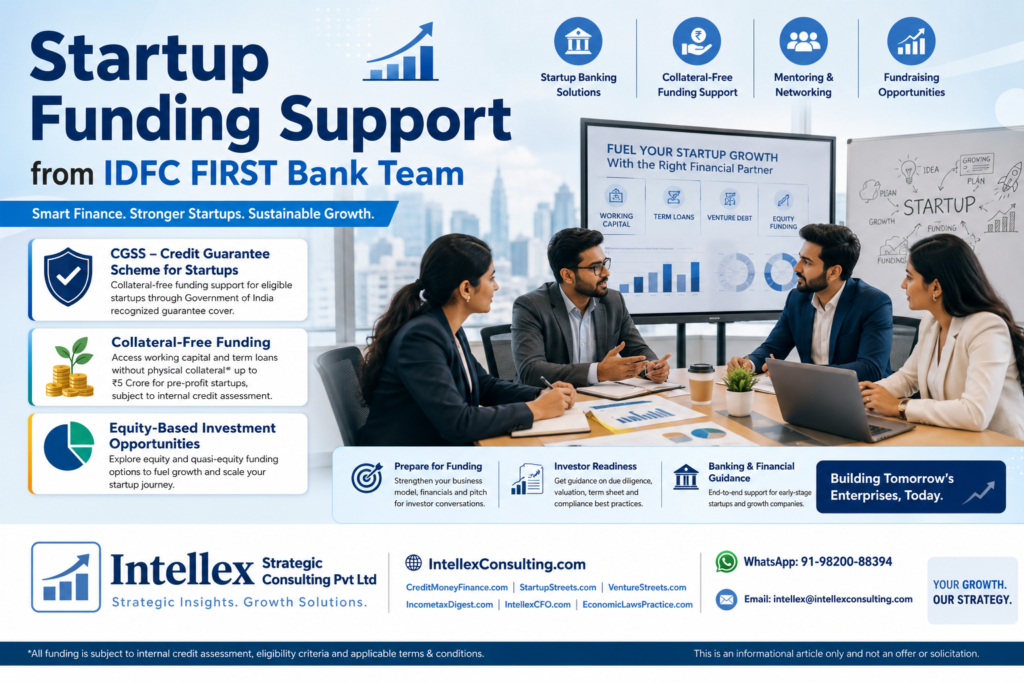
IDFC FIRST Bank Startup Funding Support: CGSS, Collateral-Free Loans, Working Capital, Equity Funding & Investor Support for Startups.
Explore IDFC FIRST Bank startup funding support including CGSS, collateral-free working capital, FIRSTWINGS, equity funding opportunities, investor connects, mentoring and financial solutions for startups and MSMEs.
India’s startup ecosystem has moved well beyond the traditional concept of simply obtaining a business loan. Today’s founders need a combination of banking infrastructure, working capital, venture debt, investor access, fundraising assistance, mentoring, financial planning and growth capital.
For startups and growth-stage companies, choosing the right financial partner can therefore have a significant impact on the ability to survive the early years, manage cash flows and scale operations.


One institution that has developed a dedicated startup ecosystem is IDFC FIRST Bank through its FIRSTWINGS Startup Banking Programme.
The bank’s current startup offering combines banking products with ecosystem initiatives such as mentoring, networking, investor connects, fundraising programmes and working-capital solutions. Its official startup platform specifically describes support for early-stage startups, growth-stage businesses and venture-funded startups.
At the same time, the Credit Guarantee Scheme for Startups (CGSS) is a Government of India-backed credit guarantee framework operated through the National Credit Guarantee Trustee Company (NCGTC). IDFC FIRST Bank is listed among the registered private-sector bank Member Institutions under CGSS.
This makes the combination of startup banking + credit guarantee-backed debt + investor readiness + fundraising support particularly relevant for founders.
What Is IDFC FIRST Bank’s Startup Support Ecosystem?
IDFC FIRST Bank’s startup proposition is built around its FIRSTWINGS Startup Banking Programme.
The programme is designed to address the financial and non-financial requirements of startups at different stages of their lifecycle.
According to the bank, its startup ecosystem includes:
- Startup current-account facilities
- Working-capital solutions
- Banking and payment solutions
- Mentoring
- Networking
- Investor connects
- Fundraising programmes
- Venture debt and venture-capital ecosystem connections
- Trade and forex solutions
- Cash-management and API banking
- Founder-focused financial services
- Startup accelerators and ecosystem initiatives
For growth-stage and venture-funded businesses, the bank also describes dedicated relationship support, working-capital solutions, trade and forex services, API banking and connections with venture debt and venture-capital networks.
This is important because a startup’s financial requirements change dramatically as it moves from idea → product development → revenue → scale → institutional funding.
1. Credit Guarantee Scheme for Startups — CGSS
The Credit Guarantee Scheme for Startups (CGSS) is one of the most important Government-backed mechanisms available to eligible startups seeking debt financing.
CGSS was established to facilitate credit to DPIIT-recognised startups by providing credit guarantee support to eligible Member Institutions.
The scheme is operated through NCGTC, rather than providing money directly to the startup.
The structure is therefore:
Government framework → NCGTC guarantee → Member Institution → eligible startup
IDFC FIRST Bank is included in NCGTC’s published list of registered CGSS Member Institutions.
How does CGSS work?
An eligible startup approaches a Member Institution for financing.
The lender independently evaluates:
- Business model
- Promoter background
- Financial performance
- Cash flows
- Repayment capacity
- Existing liabilities
- Credit history
- Business prospects
- End use of funds
- Startup eligibility
- Compliance requirements
If the proposal meets the applicable requirements, the Member Institution can seek guarantee coverage under CGSS.
The guarantee therefore reduces the lender’s credit risk; it does not mean that every startup automatically receives a loan.
2. How Much Funding Can Be Covered Under CGSS?
Under the revised framework, the maximum amount of debt eligible for guarantee coverage is ₹20 crore per borrower.
For transaction-based guarantee coverage, the scheme provides:
| Loan Amount | Guarantee Coverage |
|---|---|
| Up to ₹10 crore | 85% of amount in default |
| Above ₹10 crore | 75% of amount in default |
| Maximum eligible exposure | ₹20 crore per borrower |
These are guarantee-cover parameters and should not be interpreted as an automatic ₹20 crore loan entitlement.
The lender still determines the actual amount of finance based on its credit assessment and applicable policy.
3. Who Can Benefit From CGSS?
A startup seeking CGSS support generally needs to satisfy the applicable eligibility requirements.
The key requirements include:
DPIIT recognition
The borrower must be a startup recognised by the Department for Promotion of Industry and Internal Trade (DPIIT).
No default/NPA status
The startup should not be in default to lending or investing institutions and should not be classified as an NPA under applicable RBI guidelines.
Lender certification
The Member Institution must certify the startup’s eligibility for guarantee coverage.
Other scheme requirements
Additional conditions under the prevailing CGSS guidelines and the lender’s own credit policies also apply.
Therefore, founders should not assume that DPIIT recognition alone guarantees approval.
4. What Types of Debt Can CGSS Support?
One of the interesting aspects of CGSS is that it is broader than a conventional term loan.
The framework contemplates instruments including:
- Venture debt
- Working capital
- Subordinated debt
- Mezzanine debt
- Debentures
- Optionally convertible debt
- Fund-based facilities
- Certain non-fund-based facilities that crystallise into debt obligations
This makes the scheme potentially relevant to startups that require structured debt rather than simply a conventional business loan.
5. IDFC FIRST Bank Startup Working Capital Support
One of the most attractive aspects of IDFC FIRST Bank’s startup proposition is its working-capital solution for pre-profit startups.
The bank currently states that eligible pre-profit startups can access working-capital lending of up to ₹5 crore without physical collateral, subject to internal credit assessment and applicable terms.
This can be relevant for businesses that have:
- Growing sales
- Purchase requirements
- Vendor payments
- Receivables cycles
- Payroll requirements
- Expansion expenses
- Liquidity requirements
- Growth-related working-capital requirements
- Import/export or forex requirements
For a startup, working capital can sometimes be more important than headline equity funding.
A company may have strong revenue growth but still experience cash-flow stress because customers pay after 30, 60 or 90 days while salaries, vendors and other expenses must be paid immediately.
6. Why Collateral-Free Funding Can Be Important for Startups
Traditional business lending frequently requires collateral.
For founders who have built an asset-light technology, SaaS, D2C, fintech, consulting or digital business, substantial physical collateral may simply not exist.
Collateral-free or non-physical-collateral lending can therefore provide an alternative financing route.
However, “collateral-free” does not mean “risk-free” or “automatic approval.”
The lender may still evaluate:
- Promoter contribution
- Credit history
- Banking behaviour
- Revenue
- GST and tax records
- Cash flows
- Investor backing
- Business model
- Customer concentration
- Existing debt
- Financial projections
- Repayment capacity
Founders should therefore approach such financing with the same seriousness as an equity fundraising round.
7. FIRSTWINGS Startup Banking
IDFC FIRST Bank’s FIRSTWINGS is broader than simply providing loans.
The bank describes FIRSTWINGS as a startup ecosystem combining capital, knowledge, networks and technology.
Its current offering includes support for different categories of startups, including early-stage, growth-stage and venture-funded businesses.
For business customers, the bank highlights facilities such as:
- Startup current account
- Cash-management solutions
- API banking
- Corporate credit cards
- Working capital
- Trade and forex services
- Liquidity-management solutions
For founders, it also provides ecosystem initiatives involving mentoring, networking and fundraising.
8. Founder Success and Investor Networking
Funding is not always about approaching a bank for a loan.
A startup may instead require:
Angel investment → Seed funding → Series A → Series B → Venture debt → Growth capital
The FIRSTWINGS ecosystem therefore also focuses on connections with investors and the startup ecosystem.
IDFC FIRST Bank’s Founder Success initiatives have included programmes such as Leap To Unicorn, involving mentoring, networking and fundraising opportunities.
The bank states that selected startups can receive exposure to investors and venture capitalists through such initiatives.
This is particularly relevant to founders who need help moving from a banking relationship into the wider fundraising ecosystem.
9. Equity-Based Funding Opportunities — An Important Distinction
Founders should understand the difference between bank funding and equity funding.
Debt funding
The company borrows money and generally has to repay:
Principal + interest + applicable charges
The founders normally retain ownership, subject to the terms of the financing.
Equity funding
An investor provides capital in exchange for an ownership interest or an instrument that may convert into equity.
There is generally no conventional EMI structure like a bank loan, but founders may experience:
- Dilution
- Investor rights
- Board/information rights
- Preferred rights
- Valuation negotiations
- Exit expectations
IDFC FIRST Bank’s startup ecosystem itself distinguishes debt funding from venture capital and highlights investor access and fundraising opportunities.
Therefore, a founder should not automatically choose equity simply because it does not require EMI repayment.
10. Venture Debt — A Potential Middle Ground
For venture-funded startups, venture debt can sometimes provide additional capital without immediately requiring the same level of equity dilution as a new equity round.
It can be useful for companies that have:
- Institutional investors
- Strong growth
- Predictable cash flows
- Adequate runway
- A credible next funding milestone
- Significant receivables or business assets
The CGSS framework itself recognises venture debt as one of the instruments that may qualify for guarantee coverage, subject to the scheme requirements.
IDFC FIRST Bank also highlights connections with venture debt and venture-capital networks for its startup ecosystem.
11. Catalyst for Impact — Equity-Free Grant Support
Another programme worth knowing about is the Catalyst for Impact Programme.
This is different from a loan and different from equity investment.
IDFC FIRST Bank describes it as an equity-free CSR grant programme focused on social-impact startups in selected thematic areas.
The bank states that finalists can receive grants of up to ₹50 lakh, subject to programme parameters.
The programme includes:
- Application
- Shortlisting
- Bootcamps
- Pitch submission
- Panel review
- Due diligence
- Finalist selection
- Incubation/onboarding
Importantly, the bank states that it does not take equity in exchange for the Catalyst for Impact grants.
This can be particularly interesting for eligible startups working in social-impact areas.
12. IGNITE Programme and Impact Startups
IDFC FIRST Bank also supports startup initiatives focused on innovation and impact through programmes such as IGNITE.
The bank’s published eligibility criteria include startups that:
- Are DPIIT registered
- Have a clear social-impact solution
- Align with ESG objectives
- Operate in areas such as GreenTech/ClimateTech, HealthTech or AI for Social Good
- Have a Technology Readiness Level of 6 or above
- Meet additional programme-partner requirements
The programme combines business and market-linkage support with institutional ecosystem expertise.
This demonstrates that startup support can extend beyond conventional lending into innovation, incubation, market access and impact-oriented development.
13. Startup Current Account and Banking Infrastructure
A startup’s first relationship with a bank often begins with a current account.
But founders should think beyond merely opening an account.
A good startup banking infrastructure should support:
- Customer collections
- Vendor payments
- Payroll
- GST payments
- Subscription collections
- Payment gateways
- UPI
- Digital banking
- Cash management
- Foreign exchange
- Trade transactions
- Investor money
- Financial reporting
IDFC FIRST Bank’s FIRSTWINGS platform currently highlights startup current-account facilities and digital banking-related services as part of its startup proposition.
14. Banking Support for Venture-Funded Startups
The requirements of a venture-funded company can be significantly different from those of a traditional SME.
A venture-backed startup may need:
- Larger working-capital facilities
- Dedicated relationship management
- Investor-related banking
- Foreign exchange
- International payments
- API banking
- Treasury solutions
- Venture debt
- Share-capital account support
- Capital-flow management
IDFC FIRST Bank currently highlights purpose-built working-capital solutions for portfolio startups, along with API banking, trade/forex and share-capital account support.
15. How Should a Startup Prepare Before Approaching the Bank?
A founder should never approach a bank with only a PowerPoint presentation.
The bank needs evidence that the business can responsibly service the proposed debt.
Prepare a comprehensive funding readiness file.
Corporate documents
Keep ready:
- Certificate of Incorporation
- MOA/AOA
- PAN
- GST registration
- DPIIT recognition certificate, where applicable
- Shareholding pattern
- Board resolutions
- Statutory registrations
Financial documents
Prepare:
- Audited financial statements
- Provisional financial statements
- GST returns
- Income-tax returns
- Bank statements
- Debtors ageing
- Creditors ageing
- Cash-flow statements
- Existing loan details
- Management accounts
Business information
Prepare:
- Business plan
- Revenue model
- Customer profile
- Market size
- Competitive landscape
- Pricing strategy
- Growth strategy
- Expansion plan
Funding information
Clearly explain:
- How much money is required
- Why the money is required
- Expected utilisation
- Repayment source
- Expected cash generation
- Existing debt
- Existing investors
- Proposed funding structure
16. What Investors Want to See
A startup preparing for equity investment should additionally maintain an investor-ready data room.
This can include:
- Pitch deck
- Cap table
- Founder profiles
- Financial model
- Revenue data
- Customer metrics
- Unit economics
- CAC
- LTV
- Gross margins
- Monthly recurring revenue
- Annual recurring revenue
- Churn
- Cohort analysis
- Intellectual-property documents
- Material contracts
- Legal documents
- ESOP details
- Previous investment documents
The better organised the information, the faster due diligence can generally progress.
17. Bank Funding vs Equity Funding — Which Is Better?
There is no universal answer.
| Factor | Bank/Debt Funding | Equity Funding |
|---|---|---|
| Ownership dilution | Generally no | Yes |
| Repayment | Yes | Generally no scheduled loan repayment |
| Interest | Yes | No conventional interest |
| Cash-flow requirement | Important | Less immediate repayment pressure |
| Investor involvement | Limited/defined by facility | Often substantial |
| Suitable for | Revenue-generating businesses | High-growth businesses |
| Control | Generally retained | Potentially diluted |
| Security | Depends on facility | Equity rather than collateral |
| Growth potential | Depends on repayment capacity | Can support aggressive expansion |
The right strategy may even be a combination of equity and debt.
For example:
₹5 crore equity + ₹2 crore working capital + venture debt
may be more efficient for a particular company than raising ₹10 crore entirely through equity.
The structure should be determined by the company’s cash flows, valuation, risk profile and growth strategy.
18. How Intellex Strategic Consulting Can Support Startups
For founders, obtaining finance is only one part of the challenge.
The more difficult question is often:
Which funding source is appropriate for my company?
Intellex Strategic Consulting Pvt Ltd can assist startups and growth-stage businesses with funding-readiness and financial advisory requirements, including:
Startup Funding Strategy
Helping founders evaluate:
- Debt versus equity
- Working capital requirements
- Growth capital
- Venture debt
- Strategic investors
- Angel investors
- Family offices
- Venture capital
- Private equity
Investor Readiness
Support can include:
- Business plan preparation
- Financial projections
- Investor presentations
- Funding strategy
- Investor targeting
- Data-room preparation
- Funding documentation
- Financial modelling
Debt Funding Advisory
Businesses can be evaluated for potential:
- Working capital
- Business loans
- Structured debt
- Venture debt
- Credit-guarantee-supported financing
- Growth capital
Equity Fundraising
For suitable businesses, fundraising can involve identifying and approaching relevant:
- Angel investors
- Family offices
- Venture capital funds
- Private equity investors
- Strategic investors
- Institutional investors
The objective should not simply be to “raise money”, but to identify the right capital for the company’s stage, sector, valuation and growth strategy.
19. A Practical Funding Roadmap for Startups
Founders can follow a structured process.
Step 1 — Establish eligibility
Check DPIIT recognition and other applicable eligibility requirements.
Step 2 — Determine capital requirement
Calculate the actual requirement rather than selecting an arbitrary funding number.
Step 3 — Separate working capital from growth capital
Working capital and long-term expansion should not automatically be financed through the same instrument.
Step 4 — Evaluate debt capacity
Prepare realistic cash-flow projections and determine the amount the company can comfortably service.
Step 5 — Evaluate equity requirement
Determine whether the business needs risk capital for aggressive expansion.
Step 6 — Prepare documentation
Create a professional funding and due-diligence package.
Step 7 — Approach appropriate financing channels
Potential channels can include:
- Banks
- NBFCs
- Venture debt funds
- Angel investors
- Venture capital funds
- Family offices
- Strategic investors
- Government programmes
Step 8 — Negotiate terms
Do not evaluate funding purely on the amount offered.
Examine:
- Interest
- Processing fees
- Security
- Covenants
- Repayment
- Equity dilution
- Investor rights
- Board rights
- Exit clauses
Step 9 — Plan utilisation
The money should have a clearly defined purpose.
Step 10 — Monitor financial performance
After funding, founders should track:
- Burn rate
- Runway
- Revenue
- Gross margin
- Working capital
- Debt servicing
- Customer acquisition
- Cash conversion
20. Important: CGSS Is Not a Government Grant
This is one of the most common misunderstandings.
CGSS is a credit guarantee mechanism — not a grant.
The startup still obtains debt financing from an eligible Member Institution.
The government-backed guarantee helps reduce the lender’s credit risk subject to the scheme framework.
Therefore:
CGSS ≠ free money
and
CGSS ≠ automatic loan approval
The lender still conducts its own credit assessment and determines whether and how much financing can be sanctioned.
21. Important Disclaimer for Founders
Startups should verify the latest scheme guidelines, eligibility criteria, lending policies, pricing, documentation requirements and availability directly with the relevant financial institution before making financial decisions.
Even where a facility is described as collateral-free, other contractual requirements, guarantees, covenants or security arrangements may apply depending on the product and credit assessment.
Similarly, investor introductions or fundraising programmes do not guarantee that a startup will receive equity investment.
Funding decisions ultimately depend upon the lender’s or investor’s independent evaluation.
Conclusion: A New Approach to Startup Finance
The startup funding landscape in India is becoming increasingly sophisticated.
Founders today can potentially combine several forms of capital and support:
Banking + Working Capital + CGSS + Venture Debt + Equity + Mentoring + Investor Networks + Financial Advisory
IDFC FIRST Bank’s FIRSTWINGS ecosystem is particularly relevant because it attempts to address several of these requirements through a combination of banking and startup ecosystem initiatives. The bank currently highlights startup working-capital solutions, founder programmes, investor connects, mentoring, venture-capital and venture-debt ecosystem connections and other financial services.
For eligible DPIIT-recognised startups, CGSS adds another potentially valuable financing route, with the current framework providing guarantee coverage of up to ₹20 crore per borrower, subject to the applicable rules and lender assessment. IDFC FIRST Bank is listed by NCGTC among the registered private-sector bank Member Institutions under CGSS.
For founders, however, the most important lesson is simple:
Do not wait until the company runs out of cash to start thinking about funding.
A well-prepared startup should ideally develop its financing strategy months before the actual requirement arises.
The combination of strong financial records, realistic projections, disciplined cash management, investor readiness and the right financing partner can substantially improve a company’s ability to raise capital and scale sustainably.
Startup Funding & Financial Advisory Support
Intellex Strategic Consulting Pvt Ltd
We support startups, MSMEs and growth-stage businesses with strategic financial advisory, funding readiness, debt and equity fundraising support and investor-connect initiatives.
WhatsApp: +91-98200-88394
Email: intellex@intellexconsulting.com
Our platforms:
IntellexConsulting.com · CreditMoneyFinance.com · IncometaxDigest.com · IntellexCFO.com · EconomicLawsPractice.com · StartupStreets.com · VentureStreets.com
Important: This article is for general informational purposes and does not constitute a loan sanction, investment offer, guarantee of funding or financial/legal/tax advice. All funding is subject to eligibility, due diligence, credit assessment, investor interest and applicable terms and conditions.
Intellex Strategic Consulting Pvt Ltd
More Featured Articles:
SME IPO in India: A Comprehensive Guide for Growing Businesses Looking to Go Public:
Scaling Smart: How Businesses Can Grow Rapidly Through the Franchise Route:
Strategic Finance Options for Medical and Hospital Businesses in India (2026)
Why Every Startup and Growing Business Needs a Virtual CFO And Why IntellexCFO Is Your Best Partner
Funding and Investment Options to Grow India’s Real Estate & Allied Businesses