
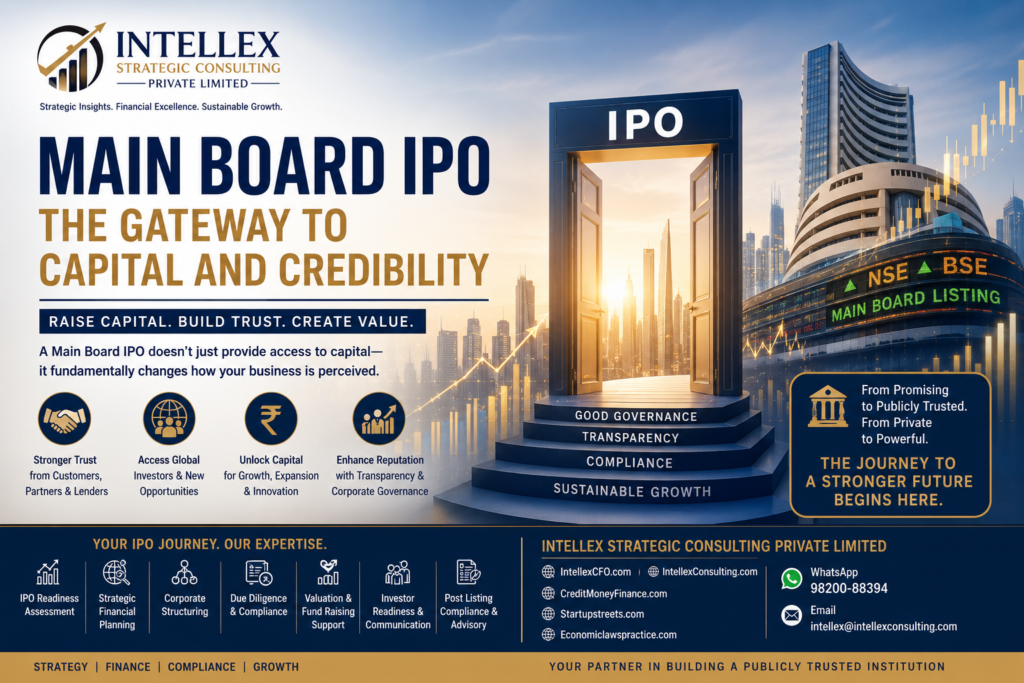
Main Board IPO in India: Complete Guide to Eligibility, SEBI Criteria, Process, Benefits & Successful Listing.
Main Board IPO: The Gateway to Capital, Credibility and Sustainable Growth – A Complete Guide for Indian Companies.
Planning a Main Board IPO in India? Learn everything about eligibility, SEBI regulations, listing process, merchant bankers, benefits, timelines, costs, and how Intellex Strategic Consulting Private Limited helps companies prepare for successful IPOs.
Main Board IPO: The Gateway to Capital and Credibility
Every ambitious company reaches a stage where organic growth alone is no longer enough. Expanding manufacturing capacity, entering new markets, investing in technology, acquiring competitors, attracting world-class talent, and building a global brand all require significant capital.
A Main Board Initial Public Offering (IPO) is one of the most transformational milestones in a company’s journey. It is much more than raising funds—it is a declaration that the business has reached a level of maturity, governance, transparency, and credibility that meets the highest standards expected by regulators, investors, institutions, and the public.
A successful Main Board IPO transforms a privately held enterprise into a publicly trusted institution.
Capital accelerates growth.
Credibility multiplies opportunities.
What is a Main Board IPO?
A Main Board IPO is the process through which a private company offers its shares to the public for the first time and gets listed on major Indian stock exchanges such as the National Stock Exchange (NSE) and the Bombay Stock Exchange (BSE).
After listing, the company’s shares are traded publicly, allowing investors to participate in its future growth.
Why Companies Choose a Main Board IPO
A listed company enjoys numerous strategic advantages:
1. Access to Large Capital
IPO proceeds can be utilized for:
- Business expansion
- New manufacturing facilities
- Research & Development
- Technology upgrades
- Debt reduction
- Working capital
- Acquisitions
- Global expansion
Unlike debt, equity capital does not require repayment or regular interest obligations.
2. Enhanced Corporate Credibility
Publicly listed companies enjoy significantly higher trust among:
- Customers
- Suppliers
- Banks
- Financial Institutions
- Global Investors
- Government agencies
- International partners
Large customers often prefer working with listed companies because they are financially transparent and professionally governed.
3. Better Brand Recognition
An IPO dramatically increases public visibility.
Media coverage, analyst reports, institutional investor interest, and market recognition contribute to stronger brand equity.
4. Liquidity for Existing Shareholders
Founders and early investors gain an opportunity to unlock value while continuing to participate in future growth.
5. Easier Future Fund Raising
Listed companies can raise additional funds through:
- Follow-on Public Offers (FPO)
- Qualified Institutional Placements (QIP)
- Rights Issues
- Preferential Allotments
- Convertible Securities
6. Employee Wealth Creation
Employee Stock Option Plans (ESOPs) become more valuable after listing, helping attract and retain top talent.
Main Board IPO Eligibility
Although eligibility depends on the applicable regulatory route and approvals, companies generally need strong financial performance, sound corporate governance, adequate public shareholding, regulatory compliance, and robust internal controls before approaching the market.
A professional IPO readiness assessment is essential to evaluate whether the business satisfies applicable listing norms.
Key Stakeholders in an IPO
A successful IPO involves multiple professionals working together:
- Merchant Banker / Book Running Lead Manager
- Legal Advisors
- Statutory Auditors
- Company Secretaries
- Registrars
- Bankers
- Underwriters
- Valuation Experts
- Public Relations Agencies
- Financial Consultants
The IPO Process
Phase 1 – IPO Readiness Assessment
- Financial health review
- Corporate restructuring
- Governance evaluation
- Risk assessment
- Internal control review
Phase 2 – Appointment of Advisors
The company appoints professional advisors to manage the IPO process.
Phase 3 – Due Diligence
Extensive verification of:
- Financial statements
- Tax matters
- Contracts
- Litigation
- Regulatory compliance
- Intellectual Property
- Licenses
- Business operations
Phase 4 – Draft Offer Document
Preparation of detailed offer documents containing:
- Business overview
- Industry analysis
- Financial performance
- Risk factors
- Promoter details
- Objects of the issue
- Management discussion
- Future strategy
Phase 5 – Regulatory Review
The draft documents undergo review by the relevant regulators and stock exchanges. Observations received are addressed before proceeding further.
Phase 6 – Marketing the IPO
Roadshows and investor presentations are conducted to attract institutional and retail investors.
Phase 7 – Price Discovery
The issue price is determined through the book-building process or another permitted pricing mechanism, depending on the structure of the offering.
Phase 8 – Public Subscription
The IPO opens for public subscription.
Investors submit bids.
Applications are processed electronically.
Phase 9 – Share Allotment
Shares are allotted based on applicable regulations and demand.
Phase 10 – Stock Exchange Listing
The company’s shares begin trading on the stock exchanges.
The business officially becomes a publicly listed company.
Life After Listing
Listing is only the beginning.
Companies must continue to maintain high standards of:
- Corporate Governance
- Financial Reporting
- Investor Relations
- Compliance
- Transparency
- Risk Management
- ESG Practices
- Board Effectiveness
Successful listed companies continuously build investor confidence.
Common Challenges Before an IPO
Many businesses are fundamentally strong but require preparation before approaching capital markets.
Common gaps include:
- Weak internal controls
- Governance improvements
- Financial restructuring
- Documentation gaps
- Compliance issues
- Tax planning
- Promoter restructuring
- Risk management
- Investor presentation readiness
Addressing these issues early significantly improves IPO readiness.
Is Your Company Ready?
Ask yourself:
- Is your business consistently profitable?
- Are financial systems robust?
- Is governance aligned with public market expectations?
- Can management handle public company responsibilities?
- Is the business scalable?
- Are compliance frameworks well established?
- Is there a compelling long-term growth story?
If the answer is “not yet,” professional preparation can bridge the gap.
How Intellex Strategic Consulting Private Limited Can Help
A successful IPO requires far more than preparing documents. It demands strategic planning, financial discipline, governance excellence, and meticulous execution.
Intellex Strategic Consulting Private Limited is a professional consulting firm that assists businesses in becoming investment-ready and preparing for sustainable long-term growth.
Our professional services include:
- IPO Readiness Assessment
- CFO Advisory Services
- Strategic Financial Planning
- Corporate Structuring
- Fund Raising Support
- Due Diligence Coordination
- Business Valuation Support
- Corporate Governance Advisory
- Financial Reporting
- Compliance Advisory
- Investor Readiness
- Business Growth Strategy
- Mergers & Acquisitions Advisory
- Business Expansion Planning
- Strategic Consulting for Promoters and Management Teams
Whether your company is planning an IPO in the near future or preparing for long-term capital market access, our experienced professionals work closely with promoters and management teams to build a strong foundation for successful listing and sustained value creation.
Contact Us
Intellex Strategic Consulting Private Limited
🌐 IntellexCFO.com
🌐 IntellexConsulting.com
🌐 CreditMoneyFinance.com
🌐 StartupStreets.com
🌐 Economiclawspractice.com
📱 WhatsApp: +91 98200 88394
📧 Email: intellex@intellexconsulting.com
Final Thoughts
A Main Board IPO is not merely a financial event—it is a transformational journey that reshapes the future of an enterprise.
It strengthens governance, enhances market reputation, attracts institutional investors, opens new avenues for capital, and positions the company for sustained long-term growth.
A Main Board IPO doesn’t just provide access to capital—it fundamentally changes how your business is perceived.
• Large customers become more comfortable entering long-term, high-value relationships.
• Global investors can discover, evaluate, and participate in your growth story.
• Promoters gain a publicly valued equity currency for future expansion, partnerships, and acquisitions.
• The company’s story shifts from being “promising” to being “publicly trusted and professionally governed.”
Capital may accelerate growth. Credibility multiplies opportunities.
The real question is not whether your company can go public.
The real question is: Is your business ready to become a publicly trusted institution?
If you are considering the IPO journey, Intellex Strategic Consulting Private Limited is ready to help you prepare, strengthen, and successfully navigate every stage toward becoming a respected listed company.
Intellex Strategic Consulting Pvt Ltd
More Featured Articles:
SME IPO in India: A Comprehensive Guide for Growing Businesses Looking to Go Public:
Pre-IPO Investment: Meaning, Benefits, Risks & How to Find Pre-IPO Opportunities.
Strategic Finance Options for Medical and Hospital Businesses in India (2026)
Scaling Smart: How Businesses Can Grow Rapidly Through the Franchise Route:
Comprehensive Accounting, Taxation, GST & Business Advisory Services in India
Why Every Startup and Growing Business Needs a Virtual CFO And Why IntellexCFO Is Your Best Partner