
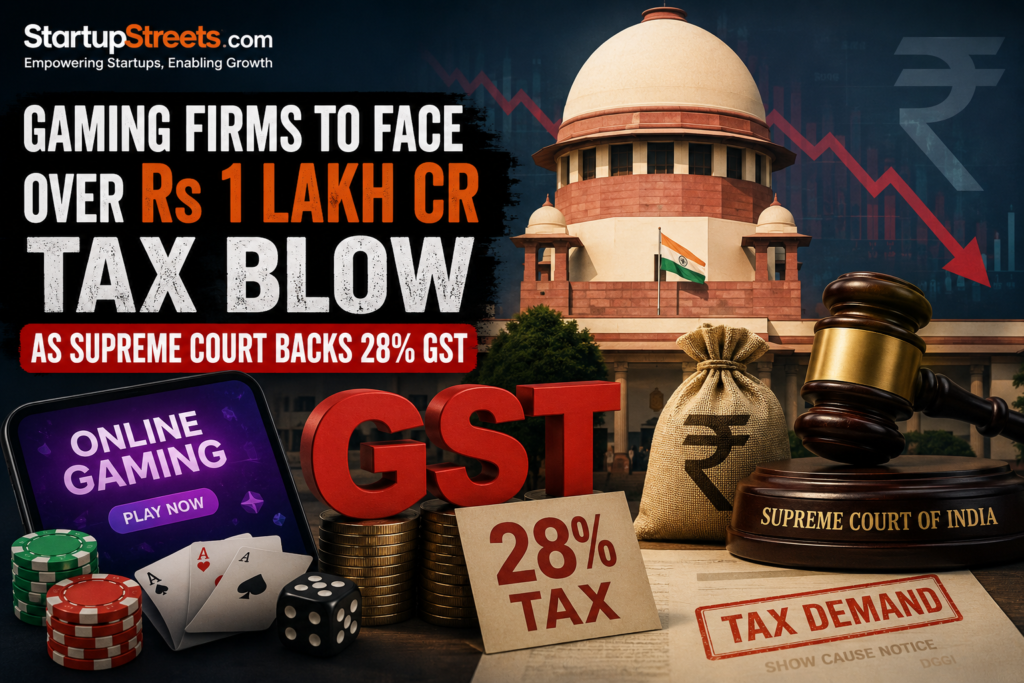
Supreme Court Upholds 28% GST on Online Gaming: Indian Gaming Industry Faces Rs 1 Lakh Crore+ Tax Shock.
The Supreme Court has upheld the retrospective 28% GST levy on online gaming companies in India, exposing the sector to tax demands exceeding Rs 1 lakh crore. Read the complete background, legal battle, implications for startups, investors, and the future of India’s gaming ecosystem.
Supreme Court Upholds 28% GST on Online Gaming: Indian Gaming Industry Faces Massive Tax Shock
India’s booming online gaming industry has suffered one of its biggest regulatory and financial setbacks after the Supreme Court upheld the government’s decision to levy 28% GST on online gaming platforms retrospectively.
The verdict potentially exposes gaming companies to tax liabilities exceeding Rs 1 lakh crore, with some estimates placing the total exposure closer to Rs 2.5 lakh crore including penalties and interest.
The ruling is expected to fundamentally reshape India’s online gaming ecosystem, impacting startups, investors, unicorns, foreign capital inflows, valuation models, and even employment generation in the sector.
For India’s startup ecosystem, this judgment is not merely a tax dispute — it is a defining moment in how the country treats digital innovation sectors involving real-money transactions.
What Was the Core Issue?
The legal dispute revolved around a simple but extremely consequential question:
Should GST be charged:
1. On Gross Gaming Revenue (GGR)?
Meaning only on the platform fee or commission earned by gaming companies.
OR
2. On Full Face Value?
Meaning on the total amount deposited or staked by users.
Gaming companies argued that they merely acted as intermediaries facilitating games of skill and should pay GST only on their platform commissions.
The government, however, argued that whenever money is staked on uncertain outcomes, the activity resembles betting and gambling, making the entire deposited amount taxable at 28%.
The Supreme Court has now sided with the government.
Background of the GST Dispute
Earlier Tax Regime
Before October 2023, most online gaming platforms paid:
- 18% GST
- Only on Gross Gaming Revenue (GGR)
- Not on the entire contest pool
For example:
If users deposited Rs 100:
- Platform commission = Rs 10
- GST applied only on Rs 10
This model aligned with global practices in jurisdictions like:
- UK
- USA
- Australia
where gaming taxes are generally imposed on net revenues rather than full player deposits.
The Government’s Shift
The situation changed dramatically after:
- The 50th GST Council Meeting
- Subsequent amendments to GST laws and rules
The government clarified that:
- Online gaming
- Casinos
- Horse racing
- Betting activities
would attract:
28% GST on the full face value of bets or deposits.
The Directorate General of GST Intelligence (DGGI) then issued massive show-cause notices to gaming firms.
The Gameskraft Trigger
The controversy exploded after Bengaluru-based gaming company Gameskraft received a GST notice reportedly exceeding Rs 21,000 crore.
The Karnataka High Court initially granted relief to the company, creating hope across the industry that the government’s interpretation could be overturned.
However, the matter eventually reached the Supreme Court, where multiple gaming firms, fantasy sports operators, and industry associations challenged:
- Retrospective taxation
- Classification of games of skill as gambling
- Taxation on total deposits instead of platform fees
What Did the Supreme Court Rule?
The Supreme Court has now upheld:
- The retrospective applicability of the 28% GST regime
- The validity of GST notices issued to gaming firms
- The government’s interpretation of taxable value
The Court reportedly observed that:
- Once players stake money on uncertain outcomes,
- The distinction between “games of skill” and “games of chance” becomes less relevant for taxation purposes.
The Court also reportedly held that online gaming companies are not mere intermediaries but taxable suppliers under GST law.
Why the Verdict Is a Massive Blow to Gaming Startups
1. Huge Retrospective Tax Liabilities
Many companies may now face:
- Massive tax recovery proceedings
- Penalties
- Interest liabilities
Several startups may simply lack the financial strength to survive.
Some estimates suggest:
- Rs 92,000 crore to Rs 2.5 lakh crore exposure industry-wide.
2. Funding Winter Could Intensify
Investors dislike:
- Regulatory unpredictability
- Retrospective taxation
- High litigation risk
This judgment may:
- Reduce venture capital inflows
- Delay IPO plans
- Depress startup valuations
- Trigger investor exits
International investors may now view India’s gaming sector as a high-risk regulatory environment.
3. Startup Closures and Consolidation
Smaller gaming startups may:
- Shut operations
- Merge with larger players
- Relocate overseas
- Exit India completely
The industry could see aggressive consolidation over the next 12–24 months.
4. Job Losses in the Digital Economy
India’s gaming industry directly and indirectly supports:
- Developers
- Designers
- Digital marketers
- Payment processors
- Influencer ecosystems
- Streaming platforms
- Ad-tech companies
A major slowdown could impact thousands of skilled digital jobs.
5. Impact on India’s Startup Narrative
India has projected itself as:
- A global startup hub
- A digital innovation powerhouse
- A future tech economy
However, retrospective taxation has historically damaged investor confidence.
The gaming verdict revives concerns about:
- Regulatory certainty
- Ease of doing business
- Policy consistency
Many investors still remember the negative global reaction to earlier retrospective tax controversies involving multinational corporations.
What Happens Next?
DGGI Recovery Proceedings Likely to Accelerate
With Supreme Court backing, authorities may now:
- Resume tax recovery actions
- Adjudicate pending notices
- Freeze assets in some cases
- Seek settlements
Industry May Seek Government Relief
The gaming industry is expected to lobby for:
- Amnesty schemes
- Waiver of penalties
- Installment-based settlements
- Prospective-only application
- Clarification on valuation methodology
There may also be pressure on the GST Council to revisit implementation mechanics.
Future of Real-Money Gaming in India
The verdict does not ban online gaming.
However, it fundamentally changes the economics of the industry.
Platforms may now:
- Increase entry fees
- Reduce prize pools
- Cut marketing spends
- Shift business models
- Explore offshore structures
Some firms may pivot toward:
- Casual gaming
- Esports
- Non-monetary gaming formats
to avoid heavy taxation exposure.
Larger Regulatory Trend Emerging in India
The online gaming GST verdict reflects a broader trend:
India is tightening oversight on digital sectors involving money flows.
This includes:
- Crypto platforms
- Betting-linked apps
- Cross-border fintech
- Offshore gaming operators
- Digital wagering ecosystems
The government’s priority appears to be:
- Tax compliance
- Consumer protection
- Financial transparency
- Prevention of unregulated betting activity
Key Takeaways for Startups and Investors
The Supreme Court verdict establishes five major realities:
1. Regulatory Risk Can Destroy Startup Economics
Even fast-growing sectors can collapse under sudden regulatory reinterpretation.
2. Retrospective Taxation Remains a Major India Risk
Global investors closely monitor such developments.
3. Gaming Startups Need Strong Legal Structuring
Future gaming ventures will require sophisticated tax planning and compliance systems.
4. Investors Will Prioritize Regulatory Stability
Funding may increasingly move toward safer sectors like SaaS, AI, fintech infrastructure, and enterprise tech.
5. India’s Gaming Industry Will Enter a Survival Phase
Only well-capitalized and compliant firms may survive the next few years.
Conclusion
The Supreme Court’s decision upholding the retrospective 28% GST levy marks a watershed moment for India’s online gaming industry.
What was once one of India’s fastest-growing startup sectors is now confronting existential financial challenges.
The verdict may redefine:
- Investor appetite
- Startup strategy
- Regulatory expectations
- Tax structuring norms
for India’s broader digital economy.
While the government sees the move as necessary for tax parity and regulation, the startup ecosystem fears the decision could significantly weaken India’s ambitions of becoming a global gaming innovation hub.
The coming months will determine whether the industry adapts, consolidates, or experiences a prolonged downturn under the weight of one of the largest tax disputes in India’s digital economy history.
Intellex Strategic Consulting Pvt Ltd
More Featured Articles:
CFO Services for Startups: Why Virtual CFOs are Becoming a Game-Changer in India
The Ultimate Guide to Company Registration in Dubai 2026: Benefits, Compliance, and Costs
Ultimate Guide to Singapore Company Registration 2026: Rules, Costs, and Compliance
Expert Guidance on Compliance for Private Limited Companies and LLP in India
Strategic Finance Options for Medical and Hospital Businesses in India (2026)
Scaling Smart: How Businesses Can Grow Rapidly Through the Franchise Route:
SME IPO in India: A Comprehensive Guide for Growing Businesses Looking to Go Public: