
GOBARdhan ₹23,731 Crore Scheme: Why Compressed Biogas (CBG) Could Create a New Wave of Business and Investment Opportunities in India.
GOBARdhan ₹23,731 Crore CBG Push: A Major Business and Investment Opportunity in India’s Waste-to-Energy Economy
India’s ₹23,731 crore GOBARdhan scheme is set to accelerate Compressed Biogas (CBG). Explore CBG plant economics, investment opportunities, financing, feedstock, offtake, pricing, infrastructure and risks for entrepreneurs and investors.
GOBARdhan Moves from Waste Management to a National CBG Industry
India’s enormous quantity of agricultural residue, cattle dung, food waste and other organic material has traditionally been viewed primarily as a waste-management challenge.
The new GOBARdhan National Circular Bioenergy Scheme, however, is attempting to turn this challenge into an industrial opportunity.
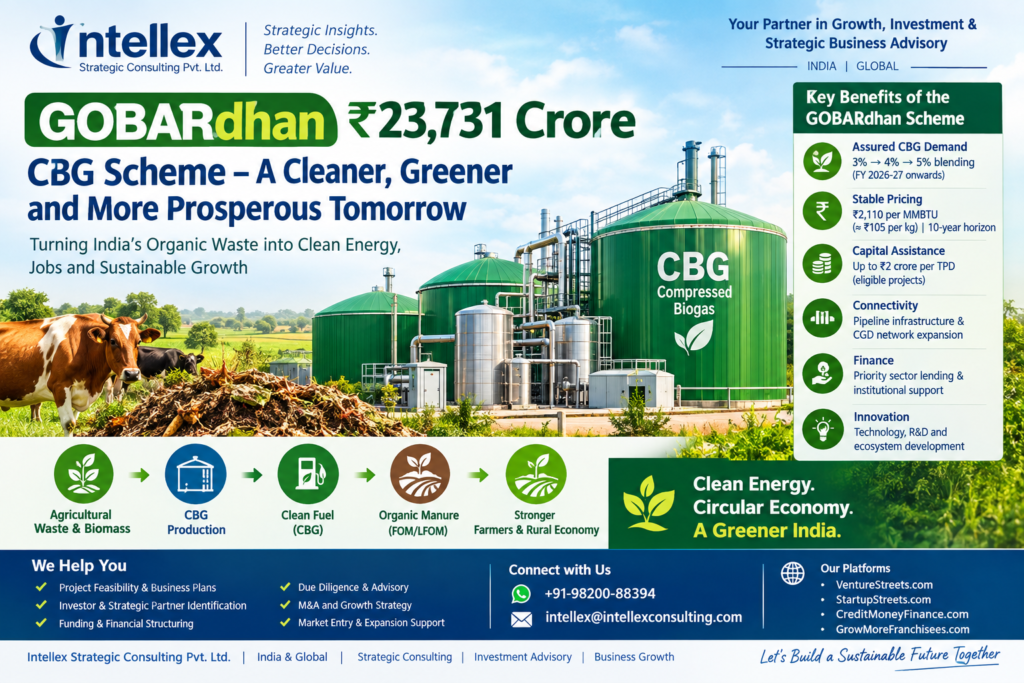
On 6 August 2026, the Union Cabinet approved GOBARdhan with a total outlay of ₹23,731 crore for FY 2026-27 to FY 2035-36. The Government’s stated objective is to nearly ten-fold domestic Compressed Biogas (CBG) production, attract private investment and develop a nationwide circular bioeconomy.
For entrepreneurs, infrastructure developers, farmers, technology companies, lenders and investors, this is important for one fundamental reason:
CBG is increasingly being treated not merely as a waste-to-energy project, but as an integrated energy, agriculture, infrastructure and rural-economy business.
What Exactly Is CBG?
Compressed Biogas is produced by processing organic feedstock through anaerobic digestion.
Depending upon the project, the feedstock can include:
- Cattle dung
- Agricultural residue
- Press mud
- Food and kitchen waste
- Municipal organic waste
- Agro-industrial waste
- Other biodegradable biomass
The biogas produced through anaerobic digestion is purified to remove impurities, particularly carbon dioxide and hydrogen sulphide, and then compressed.
The resulting CBG has properties that allow it to be used within the existing gas ecosystem.
The Government describes CBG as chemically equivalent to natural gas, allowing it to be integrated into the country’s expanding gas infrastructure.
But there is another important product.
The plant can also produce organic manure.
The digestate remaining after biogas production can be processed into products such as Fermented Organic Manure (FOM) and Liquid Fermented Organic Manure (LFOM).
Therefore, a well-designed CBG project can potentially have multiple revenue streams rather than depending entirely on gas sales.
Why the ₹23,731 Crore GOBARdhan Scheme Matters
The significance of the new framework is not simply the size of the announced allocation.
It is the attempt to address several of the traditional problems that have made CBG projects difficult to finance and scale.
The Government has structured GOBARdhan around six broad growth engines:
- Assured CBG demand
- Stable pricing
- Capital assistance
- Connectivity
- Finance
- Innovation and ecosystem development
These six areas directly address questions that investors and lenders typically ask before financing a CBG plant.
1. Assured Demand Could Improve Project Bankability
One of the biggest questions for any energy project is:
Who will buy the output?
GOBARdhan introduces an offtake assurance framework linked with the notified CBG blending obligation.
The CBG obligation trajectory is:
- 3% in FY 2026-27
- 4% in FY 2027-28
- 5% from FY 2028-29 onwards
for the CNG transport and domestic PNG segments.
This creates an important demand signal for the industry.
For a prospective investor, this means that the business plan should not simply say:
“We will manufacture CBG.”
It should demonstrate:
Where will the feedstock come from → where will the gas go → how will it reach the buyer → what price will be realized → what happens to the digestate?
That complete chain is what can turn a CBG plant into a bankable infrastructure project.
2. Stable Pricing Changes the Investment Equation
The new framework provides for an administered CBG price of ₹2,110 per MMBTU, equivalent to approximately ₹105 per kg, according to the Government’s August 2026 announcement.
The pricing framework has a minimum ten-year horizon, providing greater revenue visibility to producers.
This is particularly significant for project finance.
A lender generally wants visibility over future cash flows before providing substantial long-term debt.
A project with:
- identifiable feedstock,
- predictable production,
- contractual offtake,
- defined pricing,
- manageable operating costs,
is fundamentally different from a project that depends entirely on volatile spot-market prices.
However, investors should not interpret an administered price as a guaranteed project profit.
Profitability will still depend upon feedstock cost, plant efficiency, transportation, financing costs, downtime, manpower, maintenance, compression, purification, land and other operating expenses.
3. Capital Assistance Can Reduce the Initial Funding Requirement
The Government has announced capital assistance of up to ₹2 crore per TPD of installed CBG capacity for eligible greenfield projects.
The support can extend beyond the core plant to important value-chain assets involving feedstock aggregation, organic manure processing and value addition. Brownfield expansion projects are also covered under the framework.
This can be significant.
Consider a hypothetical project:
10 TPD CBG plant
Potential headline capital assistance could be:
10 TPD × ₹2 crore = ₹20 crore
But this should not be treated as an automatic ₹20 crore cheque to every developer.
Actual eligibility, qualifying expenditure, scheme conditions, approvals and disbursement mechanisms must be examined project-by-project.
That distinction is extremely important when preparing an investment memorandum or bankable DPR.
4. Pipeline Connectivity Is a Critical Investment Issue
Producing CBG is only half the business.
The gas must reach the customer.
India is therefore also developing pipeline infrastructure to facilitate CBG evacuation and integration into City Gas Distribution networks.
As of March 2026, the Government reported that its Development of Pipeline Infrastructure scheme had an overall outlay of ₹994.5 crore for FY 2024-25 to FY 2028-29, with financial assistance already sanctioned for projects in several states.
This creates another investment opportunity:
CBG does not only create opportunities for plant owners.
It can generate business for:
- pipeline developers,
- gas compression companies,
- transportation companies,
- biomass logistics companies,
- storage providers,
- plant EPC contractors,
- equipment manufacturers,
- monitoring and control technology companies.
The broader ecosystem may ultimately be considerably larger than the CBG manufacturing plant itself.
5. Financing Could Become a Major Growth Driver
The financing architecture is particularly relevant to investors.
CBG projects have already been recognized within the Priority Sector Lending framework, and the Ministry of Petroleum and Natural Gas has noted that several banks have developed financing products for CBG projects.
The new GOBARdhan framework is intended to further improve access to institutional finance and share part of the lending risk.
That could potentially increase participation from:
- Commercial banks
- Infrastructure lenders
- NBFCs
- Private credit funds
- Family offices
- Impact investors
- Climate-focused funds
- Renewable-energy investors
- Strategic corporate investors
For investors, this creates an interesting possibility:
Equity + project debt + government support
A properly structured CBG project may be able to combine different sources of capital rather than relying exclusively on promoter equity.
The Business Model: Where Can the Money Be Made?
A CBG project can potentially create several layers of economic activity.
1. Feedstock aggregation
Someone has to collect:
- agricultural residue,
- cattle dung,
- food waste,
- municipal organic waste,
- industrial organic waste.
This creates a potentially significant rural logistics business.
2. CBG production
This is the core business.
It involves:
- anaerobic digesters,
- gas purification,
- compression,
- storage,
- quality monitoring,
- plant operations.
3. CBG transportation and evacuation
Transportation becomes important where the plant is not directly connected to the CGD network.
4. Organic manure
FOM/LFOM can become a second commercial product.
This is strategically important because it can improve resource utilization and potentially diversify project revenues.
5. Technology
There is considerable scope for companies developing:
- digestion technology,
- gas purification,
- methane recovery,
- automation,
- sensors,
- feedstock management,
- AI-based plant monitoring,
- predictive maintenance,
- biomass mapping.
6. Project development
There is also a substantial opportunity in helping entrepreneurs identify viable locations, obtain approvals, arrange finance, negotiate offtake and construct bankable projects.
A CBG Plant Is Actually a Supply-Chain Business
This is one of the most important points prospective investors should understand.
Many first-time investors look at a CBG plant primarily as a technology project.
It isn’t.
It is equally a:
Feedstock + logistics + energy + agriculture + infrastructure + finance business.
Suppose an entrepreneur builds an excellent plant but has to transport biomass over uneconomic distances.
The project can struggle.
Conversely, a moderately sized plant located close to a large and reliable feedstock cluster, with good road connectivity and an identified gas buyer, may have significantly better economics.
Location selection therefore becomes an investment decision, not merely a real-estate decision.
What Should an Investor Examine Before Investing?
A prospective investor should conduct detailed due diligence across at least ten areas.
1. Feedstock availability
Do not rely solely on estimates.
Determine:
- annual availability,
- seasonal variations,
- competing demand,
- collection radius,
- moisture content,
- transportation cost,
- contracted versus theoretical availability.
2. Feedstock agreements
Long-term agreements with farmers, aggregators, dairies, sugar mills, food processors or municipalities can substantially strengthen the project.
3. Plant technology
Technology should be evaluated for:
- methane yield,
- feedstock flexibility,
- uptime,
- purification efficiency,
- energy consumption,
- maintenance requirements.
4. Site
Check:
- land title,
- zoning,
- water availability,
- electricity,
- road access,
- distance from feedstock,
- distance from CGD/pipeline infrastructure.
5. Offtake
A strong project should establish who will purchase the CBG and under what contractual framework.
6. Pricing
The financial model should reflect the applicable current pricing mechanism and all relevant costs—not simply assume the headline government price equals profit.
7. Manure economics
Investigate the expected production, quality, market and realization of FOM/LFOM.
8. Project debt
Assess:
- debt-equity ratio,
- interest rate,
- repayment period,
- DSCR,
- collateral requirements,
- promoter contribution.
9. Government assistance
Every subsidy or capital-support assumption should be independently verified against applicable guidelines and project eligibility.
10. Promoter capability
CBG is an operational business.
Investors should examine whether the promoter has access to competent teams for:
- biomass procurement,
- plant operations,
- engineering,
- finance,
- regulatory compliance,
- sales and logistics.
Existing Industry Base Provides an Important Starting Point
The opportunity is not being created from zero.
According to the Government, 1,908 CBG/Bio-CNG plants had been registered as of 6 August 2026, of which 217 had been commissioned and 339 were under construction. A subsequent government update reported 1,929 registered plants as of 13 August 2026, with 217 commissioned and 357 under construction.
That suggests an ecosystem is already developing.
The challenge now is moving from registrations and individual projects to commercially sustainable, efficiently operated and financeable projects at scale.
Which States Could Offer Opportunities?
CBG is particularly interesting in areas with combinations of:
- high agricultural output,
- large cattle populations,
- sugar mills,
- dairy clusters,
- food-processing industries,
- municipal organic waste,
- existing CGD infrastructure.
Government-supported biomass aggregation activity has already involved states including Maharashtra, Gujarat, Madhya Pradesh, Andhra Pradesh, Chhattisgarh, Odisha, Punjab, Rajasthan, Telangana and Uttar Pradesh, among others.
For investors, however, state-level potential should not substitute for project-level due diligence.
A district with abundant biomass but poor evacuation infrastructure may be less attractive commercially than a smaller feedstock cluster located close to an established gas network.
Opportunities Beyond Large CBG Plants
An interesting aspect of the emerging ecosystem is that investors do not necessarily have to build a huge CBG plant.
Potential businesses include:
Biomass aggregation companies
Collecting and supplying feedstock to multiple plants.
Equipment companies
Manufacturing or supplying:
- digesters,
- compressors,
- purification equipment,
- pumps,
- storage systems,
- automation equipment.
Technology startups
Building software and technology around:
- biomass mapping,
- supply-chain optimization,
- plant monitoring,
- methane-yield optimization,
- predictive maintenance.
Organic manure businesses
Processing, packaging and marketing FOM/LFOM.
Waste-management companies
Municipal and industrial organic-waste processing.
Logistics companies
Specialized transportation of biomass and digestate.
Project development companies
Identifying sites, preparing DPRs, arranging approvals and coordinating EPC, finance and offtake.
What Are the Major Risks?
The Government’s policy support improves the framework, but it does not eliminate commercial risk.
Investors should pay particular attention to:
Feedstock risk: Actual collectible biomass may be lower than theoretical availability.
Logistics risk: Transportation can significantly affect margins.
Technology risk: Digesters and purification systems must operate consistently.
Execution risk: Construction delays can increase interest during construction and postpone revenue.
Offtake risk: Contractual arrangements need careful examination.
Policy risk: Investors must monitor future changes in pricing, blending requirements and subsidy mechanisms.
Manure-market risk: Digestate is valuable only if it can be processed, certified, transported and sold economically.
Financing risk: Higher-than-expected debt costs can materially alter project returns.
Environmental and regulatory risk: Local permissions, waste handling requirements and environmental compliance must be addressed before financial closure.
What Could Make a CBG Project Attractive to Investors?
A strong investment proposition could potentially look like this:
Reliable local feedstock + long-term feedstock contracts + efficient technology + identified CBG offtake + pipeline/logistics access + government support + manageable debt + additional manure revenue.
This combination is much more important than simply having a large theoretical production capacity.
For investors evaluating opportunities, project quality should be assessed at the entire value-chain level.
GOBARdhan and the Larger Circular Economy
The bigger story goes beyond CBG.
The scheme is attempting to create an economic cycle:
Agricultural waste → Biomass aggregation → CBG production → Clean fuel → Organic manure → Agriculture
This can create a localized economic ecosystem involving farmers, entrepreneurs, transporters, technology companies, plant operators, financial institutions and energy companies.
The Government estimates that over the decade the programme could result in more than ₹75,000 crore of additional GDP, generate over 1.5 lakh jobs, displace about 10 MMT of fossil fuel use, and produce approximately 250 MMT of organic fertilizer, while reducing greenhouse-gas emissions. These are government projections, not guaranteed outcomes.
A New Opportunity for Entrepreneurs and Investors
The ₹23,731 crore GOBARdhan framework should therefore be viewed as more than a government subsidy programme.
It represents an attempt to build a national CBG ecosystem.
For entrepreneurs, the opportunity may lie in building plants, aggregation networks, technology platforms, logistics businesses or organic-manure businesses.
For investors, opportunities can potentially exist across:
- Project equity
- Growth capital
- Private credit
- Infrastructure finance
- Equipment finance
- Technology investment
- Waste-management platforms
- Biomass aggregation
- Renewable-energy businesses
- Rural infrastructure
The key is to distinguish between a project that qualifies for government support and a project that is commercially investable.
Those are not automatically the same thing.
How Intellex Strategic Consulting Can Help CBG Entrepreneurs and Investors
The emerging CBG ecosystem will require substantial professional support—from project identification and feasibility analysis to funding, financial structuring and investor outreach.
Intellex Strategic Consulting Pvt. Ltd. works with businesses and investors across India and internationally on strategic consulting, investment opportunities, fundraising, financial advisory and business growth initiatives.
For entrepreneurs considering a CBG, Bio-CNG, waste-to-energy, biomass or circular-economy project, professional assistance can be valuable in areas such as:
- Project feasibility assessment
- Business-plan and financial-model development
- Project structuring
- Investor and strategic-partner identification
- Equity fundraising
- Debt and project-finance preparation
- Investor presentations
- Due-diligence preparation
- Strategic business development
- M&A and investment opportunities
- Expansion and growth strategy
For investors, professional evaluation can help in screening opportunities, understanding project economics, reviewing business models and identifying suitable investment structures.
Relevant Intellex platforms
VentureStreets.com – Startup funding, fundraising and investor advisory
StartupStreets.com – Startup ecosystem, business and investment opportunities
CreditMoneyFinance.com – Finance, credit, investment and financial-market information
GrowMoreFranchisees.com – Business expansion, franchise and investment opportunities
CBG Is Moving Into an Institutional Investment Phase
India’s CBG story has been developing for several years through SATAT and other government initiatives. The GOBARdhan framework now attempts to bring demand, pricing, capital assistance, connectivity, finance and ecosystem development into a more integrated structure.
That makes the next phase particularly relevant to entrepreneurs, infrastructure developers, lenders, family offices, private investors and strategic corporations.
The winners in this emerging ecosystem will not necessarily be the companies with the largest plants.
The commercially important question will be:
Who can build a reliable, scalable and financially sustainable connection between India’s waste resources and its growing demand for clean gas?
That is where the real business opportunity in India’s CBG economy may emerge.
For CBG, Waste-to-Energy & Investment Advisory
Intellex Strategic Consulting Pvt. Ltd.
WhatsApp: +91-98200-88394
Email: intellex@intellexconsulting.com
Websites:
VentureStreets.com | StartupStreets.com | CreditMoneyFinance.com | GrowMoreFranchisees.com
This article is for general business and investment information. Government scheme benefits, eligibility, pricing, capital assistance and financing should be independently verified against the applicable official guidelines before making an investment or committing capital.
More Featured Posts:
Write for Top Business & Finance Platforms – Guest Blogging Opportunity with Global Reach.
Strategic Finance Options for Medical and Hospital Businesses in India (2026)
Scaling Smart: How Businesses Can Grow Rapidly Through the Franchise Route:
Why Every Startup and Growing Business Needs a Virtual CFO And Why IntellexCFO Is Your Best Partner