
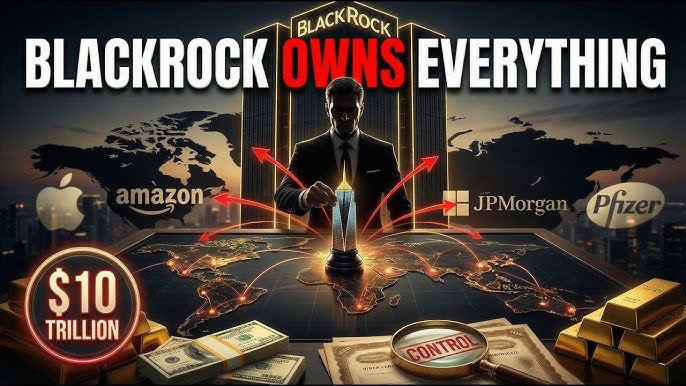
BlackRock’s $10.5 Trillion Empire: If It Were a Country, It Would Be the World’s 3rd Largest Economy
When we think of global financial superpowers, we typically picture nations, America, China, Germany, India. But in the world of markets and money, power doesn’t always sit with governments.
Some of it rests with institutions so vast that they quietly shape policy, move markets, and influence corporate behavior across continents.
BlackRock is one of them.
With over $10.5 trillion in assets under management (AUM), BlackRock is not just the largest asset manager in the world, it represents a level of financial reach that is almost geopolitical. If its capital base were measured as national output, BlackRock would be the third-largest “economy” on Earth, trailing only the United States and China.
It would be larger than Japan, Germany, India, and even bigger than the combined GDP of the UK, France, and Canada.
Also Read the Following:
Funding & Investment Options to Grow India’s Real Estate & Allied Businesses
Yet here’s the twist:
BlackRock doesn’t own most of this money. It manages it on behalf of pensioners, sovereign wealth funds, governments, corporations, insurers, universities, and regular investors.
Even so, the power that comes with managing such a sum is enormous. Let’s explore how a firm that holds no political office has become one of the most influential forces in global capitalism.
What Does “Assets Under Management” Really Mean?
Assets under management represent the total value of investments a firm oversees for clients.
These assets might include:
Company retirement accounts
National pension programs
Wealth funds of countries
Mutual funds and ETFs
Institutional portfolios
Endowments and corporate reserves
BlackRock’s role is to invest, allocate, analyse, and steward this capital.
In return, it charges fees, tiny percentages that add up massively when dealing with trillions.
How Big Is $10.5 Trillion, Really?
To grasp the scale, consider these comparisons:
Entity / Country Approx. GDP
United States – $27T
China. – $18T
BlackRock (AUM) – $10.5T
Japan. – $5T
Germany – $4.5T
India – $3.7T
UK + France + Canada (combined) – $8–9T
So BlackRock, as a manager of capital, outmatches the GDP of entire industrialised nations.
If BlackRock Were a Country
Let’s imagine BlackRock as a sovereign state:
It would rank 3 in economic output.
It would have financial tentacles tied to thousands of companies globally.
It would influence:
Employment
Manufacturing priorities
Corporate social responsibility
Dividend policies
CEO appointments
Climate and sustainability decisions
And unlike governments tied to borders, BlackRock operates everywhere.
Also Read the Following:
SME IPO in India 2025: Complete Guide for Investors & Growing Businesses
Who Owns the Money BlackRock Manages?
Here’s where people misunderstand:
BlackRock doesn’t own trillions, it acts as a custodian and allocator.
Its clients include:
✔ Pension funds
✔ Insurance companies
✔ Central banks
✔ Sovereign wealth funds
✔ Governments
✔ Corporations
✔ Wealthy individuals
✔ Millions of ETF investors through iShares
These stakeholders entrust BlackRock to manage money responsibly, grow their savings, and reduce risk.
However, managing wealth gives BlackRock influence, and influence is a currency of its own.
The Source of BlackRock’s Power Isn’t Ownership, It’s Stewardship
Because BlackRock holds shares across thousands of public companies often as a top shareholder. It can:
Vote on board appointments
Influence corporate strategy
Shape ESG (environmental, social, governance) policies
Advocate for changes in how companies behave
For example:
If BlackRock says it wants more climate risk disclosure from energy companies or better supply chain transparency from manufacturers, those firms listen because failing to do so risks shareholder backlash.
This means BlackRock has more sway over corporate behavior than many governments or regulators.
BlackRock’s Global Network
Beyond investments, BlackRock provides consulting, technology, and risk-management tools to governments.
Notably:
Its risk platform, Aladdin, is used by not only financial institutions but official bodies.
BlackRock executives have held advisory roles with central banks and governments.
During periods of crisis , such as the 2008 financial crash and the 2020 pandemic, governments tapped BlackRock for operational guidance on asset purchase programs.
To some critics, this blurs the line between private power and public governance.
The Rise of iShares and the ETF Revolution
One reason BlackRock grew to its mega-status is the ETF boom.
BlackRock owns iShares, the world’s largest ETF provider.
ETFs are:
Low-cost
Easy to buy and sell
Attractive to both retail investors and institutions
Through iShares, BlackRock channels:
✔ Retirement savings
✔ National pension allocations
✔ Retail investors buying index funds
This pipeline gives BlackRock immense voting rights across global markets.
Even though it doesn’t “own” the underlying companies, it often decides how shareholder votes are cast, a silent force in boardrooms worldwide.
Also Read the Following:
IntellexCFO.com – Strategic CFO & Funding Solutions for Growth
Geopolitical Influence Without Political Office
BlackRock touches nearly every sector:
Energy
Healthcare
Technology
Banking
Utilities
Defense
Consumer goods
Real estate
Its influence extends into:
✔ ESG policy (climate, governance, reporting)
✔ Corporate strategy alignment
✔ Shareholder activism
✔ Market liquidity management
This makes it a private institution acting like a global regulator, which has raised questions:
Should asset managers be able to dictate social policy?
Do they represent citizens or elites?
Are they accountable enough?
The Critics: Too Big to Influence?
Critics argue BlackRock holds:
Excess market concentration
Systemic risk potential
Political influence without voter oversight
Concerns include:
1. Conflicts of interest
Advising governments while profiting from policies they shape could be seen as problematic.
2. Market power concentration
When one shareholder owns a large portion of virtually every major company, competitive dynamics weaken.
3. Lack of transparency
Who really benefits from BlackRock’s sway—customers or its own executives?
Also Read the Following:
Angel Investing in Bharat: The New Wave of Micro-Angels
The Defense: “We Don’t Own the Money”
BlackRock counters by highlighting:
✔ Its fiduciary duty
✔ Its role as a steward, not proprietor
✔ The fact it acts on instructions from stakeholders
✔ Growing investor-driven demand for ESG focus
Its argument:
If pensioners and governments want sustainability and corporate governance alignment, BlackRock merely executes those desires.
The Quiet Future: An Unelected Global Power Broker?
What makes BlackRock extraordinary is its non-state status.
Governments:
Are elected
Are accountable to borders
Answer to laws
BlackRock:
Moves money beyond borders
Speaks quietly but powerfully
Influences outcomes without public hearings
In a world where capital is global but governance is national, institutions like BlackRock function in the gaps almost like financial superstates.
Also Read the Following:
Fireside Ventures Closes ₹2,265 Crore Fund IV — A Big Boost for India’s Consumer Brands Boom
What Happens Next?
Three trajectories are shaping BlackRock’s future:
1. Regulatory Pushback
The EU, US, and China are debating asset-concentration policies.
Rules over voting rights, governance obligations, and ESG influence are tightening.
2. Technology & AI Expansion
BlackRock’s risk platform Aladdin already influences trillions in assets outside BlackRock itself.
Deeper automation may embed it further into government and institutional decisions.
3. Growing Public Scrutiny
As news spreads about BlackRock being “bigger than countries,” expect more debate:
Should an unelected fund manager influence climate policy?
Should shareholder power be decentralised?
Do pensioners understand how their votes are being cast?
Conclusion: Financial Power Beyond Borders
In pure scale, BlackRock is not a country, but it rivals one.
Its assets under management exceed:
The GDP of almost every nation
The combined output of major Western economies
The wealth controlled by most political institutions
Even without owning capital directly, it shapes the flow of global money, corporate decisions, investment strategy, and policy priorities.
BlackRock is not merely an asset manager, it is a financial ecosystem, and the world’s markets largely move within currents it influences.
As geopolitics, economics, and technology evolve, the question becomes:
Who governs financial power when it sits outside national borders?
BlackRock—huge, quiet, and structurally embedded forces us to confront that question.
Team: Credit Money Finance
Also Read the Following Article: