
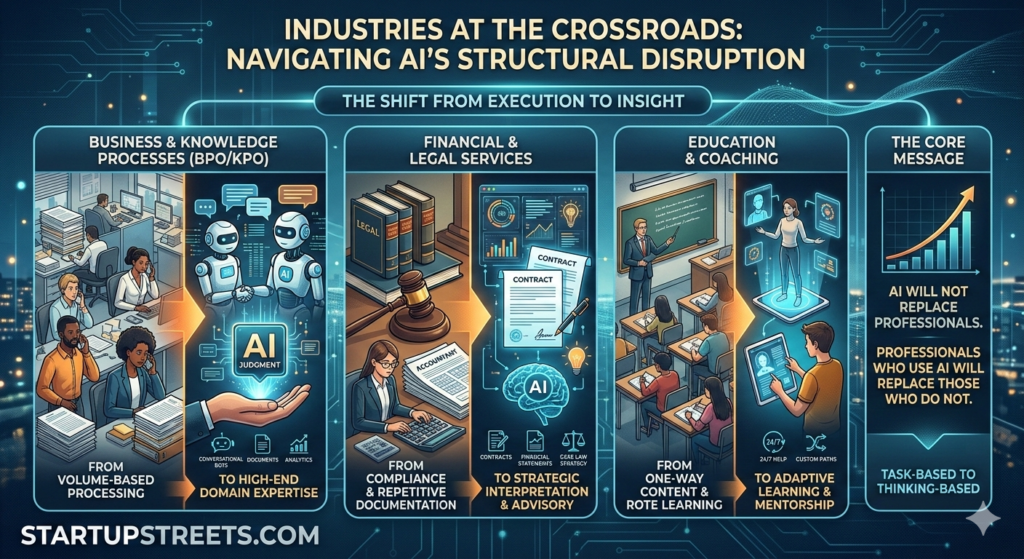
The AI Paradigm Shift: Navigating Structural Disruption in Service Sectors.
Artificial Intelligence is reshaping global service industries including BPO, accounting, legal services, education, and financial advisory.
Discover how AI is disrupting traditional business models and why professionals must shift from process-driven work to strategic insight.
Artificial Intelligence represents more than a mere technological trend; it is a fundamental structural shift. Unlike previous revolutions, its impact is characterized by exponential velocity.
While AI acts as a catalyst for innovation, it simultaneously poses a significant threat to traditional service models predicated on routine, repetitive, and process-driven workflows.
For firms and professionals in these sectors, the transition is no longer optional, it is a matter of survival.
1. Business & Knowledge Process Outsourcing (BPO/KPO)
The traditional cost-arbitrage model, which has historically fueled growth in emerging markets like India, is facing an existential challenge. AI is rapidly neutralizing the advantage of human-led data entry and basic analytics.
- The Disruption: Advanced conversational AI and automated document processing are replacing manual customer support and back-office functions.
- The Shift: Success will migrate from volume-based processing to judgment-based, domain-specific expertise.
2. Accounting, Audit, and Tax Compliance
The automation of financial hygiene is near-complete. Tools now possess the capability to classify transactions, perform instant reconciliations, and file routine compliance documents with higher accuracy than human counterparts.
- The Disruption: Standard bookkeeping and data compilation are becoming commoditized.
- The Shift: Professionals must pivot from compliance-heavy roles to strategic advisory, focusing on tax structuring and sophisticated financial interpretation.
3. Legal Services and Documentation
Large Language Models (LLMs) have proven exceptionally adept at the “heavy lifting” of the legal profession: research and drafting.
- The Disruption: Automated systems can now draft standard contracts, perform due diligence at scale, and summarize vast case law repositories in seconds.
- The Shift: Value will no longer reside in document generation, but in litigation strategy, nuanced negotiation, and complex jurisdictional interpretation.
4. Education and Standardized Coaching
Any pedagogical model centered on one-way content delivery or rote memorization is highly vulnerable to AI’s hyper-personalization capabilities.
- The Disruption: Adaptive learning platforms provide 24/7 personalized tutoring, rendering static lecture-based models obsolete.
- The Shift: The educator’s role must evolve from an information source to a mentor and capability builder.
5. Intermediary-Led Financial Services
In an era of transparent data, the “middleman” in financial distribution is seeing their margins erode.
- The Disruption: AI-driven robo-advisory and comparison engines offer objective, data-backed recommendations for insurance, loans, and mutual funds.
- The Shift: Advisors must move beyond product sales toward holistic, trust-based wealth management and multi-generational estate planning.
Conclusion: From Execution to Insight
The transition facing the global economy is clear: we are moving from a task-based economy to a thought-based economy. AI is not a replacement for professional judgment; it is a replacement for mechanical execution. In the coming decade, the market will stop paying for “hours worked” and start paying exclusively for “value delivered.” For those who leverage AI to augment their insight, the opportunities are boundless. For those who remain tethered to process, the risks are absolute.
The question is no longer “Will AI impact my industry?” but rather: “Is my business model built on a task, or a strategy?”
Team: StartupStreets.com
More Featured Articles:
Masna Ventures Launches $100M Defense Tech Fund: A New Era for Saudi Defense Innovation.
Unicorn India Ventures Closes ₹1,200 Crore Fund III: A Deeptech Goldmine for Indian Startups.
Arkin Bio Ventures III: Arkin Capital Closes $100M Fund to Fuel Global Biotech Innovation
The Rise of ClimateTech and AgriTech Startups in India: Innovation for a Sustainable Future
IIT Bombay Launches First-of-Its-Kind ₹250 Crore Deep-Tech VC Fund to Empower Early-Stage Startups
Backbiome is a naturally crafted, research-backed daily supplement formulated to gently relieve back tension and soothe sciatic discomfort.
GL Pro is a natural dietary supplement formulated to help maintain steady, healthy blood sugar levels while easing persistent sugar cravings.
MounjaBoost is a next-generation, plant-based supplement created to support metabolic activity, encourage natural fat utilization
Backbiome is a naturally crafted, research-backed daily supplement formulated to gently relieve back tension and soothe sciatic discomfort.
MounjaBoost is a next-generation, plant-based supplement created to support metabolic activity, encourage natural fat utilization
ViriFlow is a dietary supplement formulated to help maintain prostate, bladder, and male reproductive health. Its blend of plant-based ingredients is designed to support urinary comfort and overall wellness as men age.
Visium Pro is an advanced vision support formula created to help maintain eye health, sharpen visual performance, and provide daily support against modern challenges such as screen exposure and visual fatigue.
Nitric Boost Ultra is a daily wellness formula designed to enhance vitality and help support all-around performance.
AquaSculpt is a high-quality metabolic support supplement created to help the body utilize fat more efficiently while maintaining steady, reliable energy levels throughout the day.
NativeGut is a precision-crafted nutritional blend designed to nurture your dog’s digestive tract.
GL Pro is a natural dietary supplement formulated to help maintain steady, healthy blood sugar levels while easing persistent sugar cravings.
Prosta Peak is a high-quality prostate wellness supplement formulated with a comprehensive blend of 20+ natural ingredients and essential nutrients to support prostate health
AquaSculpt is a high-quality metabolic support supplement created to help the body utilize fat more efficiently while maintaining steady, reliable energy levels throughout the day.
Prostadine concerns can disrupt everyday rhythm with steady discomfort, fueling frustration and a constant hunt for dependable relief.
NativeGut is a precision-crafted nutritional blend designed to nurture your dog’s digestive tract.
Kerassentials is an entirely natural blend crafted with 4 potent core oils and enriched by 9 complementary oils and vital minerals.
HeroUP is a premium mens wellness formula designed to support sustained energy, physical stamina, and everyday confidence.
Boostaro is a purpose-built wellness formula created for men who want to strengthen vitality, confidence, and everyday performance.
Prosta Peak is a high-quality prostate wellness supplement formulated with a comprehensive blend of 20+ natural ingredients and essential nutrients to support prostate health
NerveCalm is a high-quality nutritional supplement crafted to promote nerve wellness, ease chronic discomfort, and boost everyday vitality.
Nitric Boost Ultra is a daily wellness formula designed to enhance vitality and help support all-around performance.
ProstAfense is a premium, doctor-crafted supplement formulated to maintain optimal prostate function, enhance urinary performance, and support overall male wellness.
NerveGenics is a naturally formulated nerve-health supplement created to promote nerve comfort, cellular energy support, antioxidant defense
The bodys natural process of skin cell renewal is essential for preserving a smooth, healthy, and youthful-looking complexion.
Manergy is an advanced male vitality supplement created to help support healthy testosterone levels
Arialief is a carefully developed dietary supplement designed to naturally support individuals dealing with sciatic nerve discomfort while promoting overall nerve wellness.
InsuLeaf is a high-quality, naturally formulated supplement created to help maintain balanced blood glucose, support metabolic health, and boost overall vitality.
Gluco6 is a natural, plant-based supplement designed to help maintain healthy blood sugar levels.
Maintaining prostate health is crucial for men’s overall wellness, especially as they grow older. Conditions like reduced urine flow, interrupted sleep
PurDentix is a revolutionary oral health supplement designed to support strong teeth and healthy gums. It tackles a wide range of dental concerns
Mitolyn is a carefully developed, plant-based formula created to help support metabolic efficiency and encourage healthy, lasting weight management.
ProDentim is a distinctive oral-care formula that pairs targeted probiotics with plant-based ingredients to encourage strong teeth, comfortable gums, and reliably fresh breath.
**nerve calm**
NerveCalm is a high-quality nutritional supplement crafted to promote nerve wellness, ease chronic discomfort, and boost everyday vitality.
**neurosharp**
Neuro Sharp is a modern brain-support supplement created to help you think clearly, stay focused, and feel mentally confident throughout the day.
**prodentim**
ProDentim is a distinctive oral-care formula that pairs targeted probiotics with plant-based ingredients to encourage strong teeth, comfortable gums, and reliably fresh breath.
**prostafense**
ProstAfense is a premium, doctor-crafted supplement formulated to maintain optimal prostate function, enhance urinary performance, and support overall male wellness.