
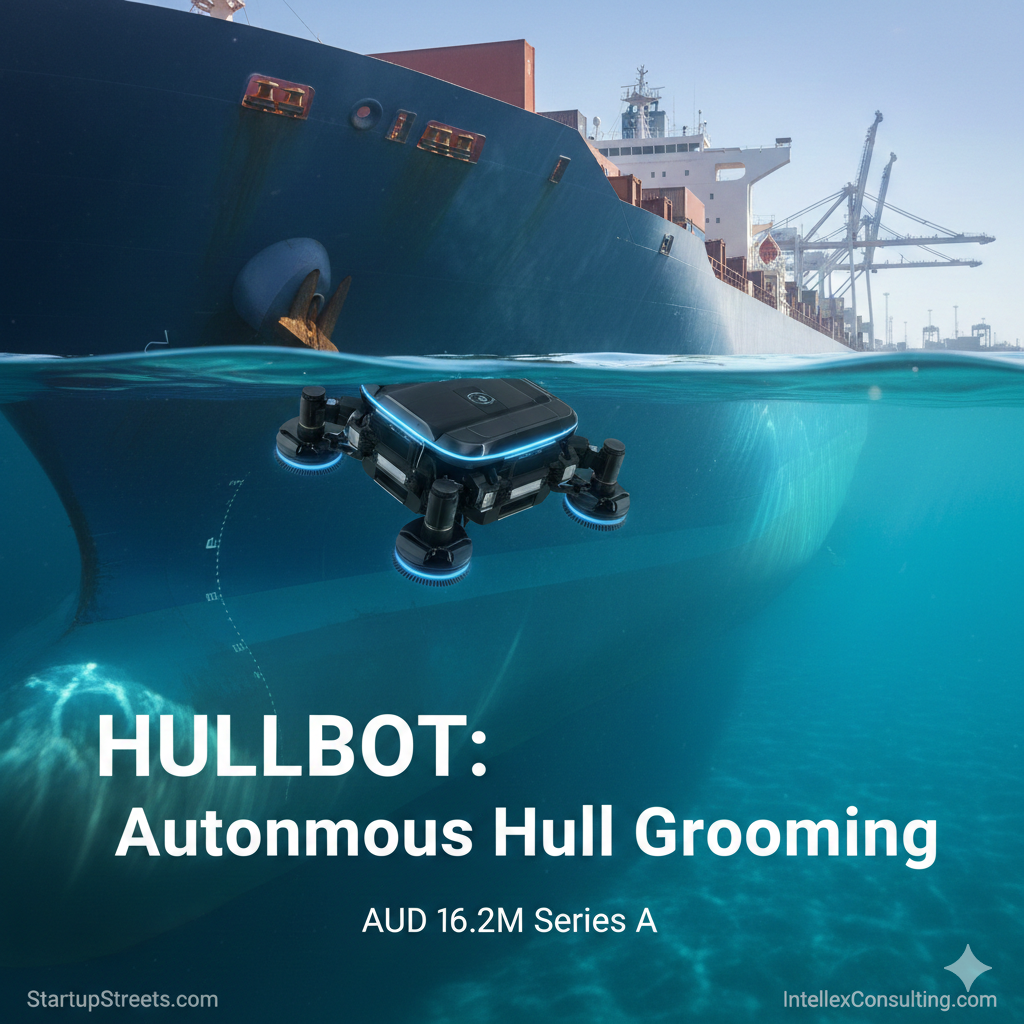
Hullbot’s AUD 16.2M Series A: The Autonomous Future of Sustainable Shipping.
Discover how Hullbot, the Australian ocean robotics pioneer, secured AUD 16.2M in Series A funding to revolutionize vessel maintenance with autonomous underwater robots that slash fuel costs and carbon emissions.
The maritime industry is facing a dual challenge: the urgent need to decarbonize and the rising cost of fuel. Addressing these head-on is Hullbot, an Australian-based robotics innovator that recently made waves by filing an AUD 16.2 million (USD 10.6 million) Series A funding round.
Initially announced in late 2025, this capital injection signals a massive shift in how the world’s fleets maintain their most critical asset, the hull. By replacing manual divers and toxic paints with autonomous “grooming” robots, Hullbot is proving that ocean health and operational efficiency are no longer at odds.
Also Read: Ultimate Guide to Early Stage Startup Funding in MENA (2026): Top Investors & Strategies
The Genesis: From a University Project to Global Innovation
Hullbot’s journey began at the University of New South Wales (UNSW). Founded by Tom Loefler, an industrial designer and inventor with a background in mechanical engineering and boat building, the company was born out of a desire to solve “biofouling.”
Biofouling, the accumulation of algae, barnacles, and marine growth is a silent profit killer. Even a thin layer of slime can increase a vessel’s drag, leading to a 10% to 26% increase in fuel consumption. Loefler’s vision was to create a robot that could “groom” the hull frequently and gently, preventing growth before it starts, rather than the traditional method of waiting for heavy growth and scraping it off (which often damages expensive protective coatings).
Key Milestones in Hullbot’s Evolution:
- Spin-out Success: Hullbot emerged as a UNSW spin-out and participated in the Defence 10x Accelerator.
- Prototyping: The technology underwent six major iterations before the current H6 model became the industry standard.
- Early Adoption: The company quickly secured landmark customers, including Sydney Ferries and NRMA Marine.
The Business Model: Cleaning as a Service (CaaS)
Unlike traditional robotics companies that sell hardware, Hullbot operates on a Cleaning as a Service (CaaS) model. This approach removes the “upfront cost” barrier for fleet operators.
The Technology Advantage
Hullbot’s robots are unique “free-swimming” AUVs (Autonomous Underwater Vehicles). They utilize:
- Advanced Computer Vision: Using proprietary AI and cameras to navigate complex hull geometries (propellers, rudders, and niche areas) in murky water.
- Frequent Grooming: By cleaning “early and often,” the robots use soft brushes that don’t damage hull coatings, unlike the aggressive scrubbing used by divers.
- Data-Driven Insights: Every clean generates a digital twin of the hull, providing operators with high-definition inspection reports and performance analytics.
Impact Check: To date, Hullbot has completed over 1,000 paid cleans on 82+ vessels, preventing over 4,000,000 kg of CO₂ emissions.
Investment Deep Dive: The Series A Power Players
The AUD 16.2 million Series A round, finalized in late 2025, was led by Los Angeles-based Regeneration.VC, a firm focused on the circular economy and climate tech. This round was oversubscribed, reflecting high investor confidence in “hard-to-abate” sector solutions.
Investor | Type/Focus |
|---|---|
Regeneration.VC | Lead Investor; Climate & Circularity |
Climate Tech Partners | Australian-based emissions reduction fund |
Katapult Ocean | Ocean-impact specialized venture capital |
Folklore Ventures | Long-term Australian tech backers |
NewSouth Innovations | UNSW’s commercialization arm |
Other Backers | Rypples, Trinity Ventures, Artesian, Bandera Capital |
Also Read: Family Office Investments in India: Fueling Startups, Scaleups & Growth-Stage Enterprises
Past Funding & Growth
Prior to the Series A, Hullbot was supported by seed-stage investors like Boost VC and participated in strategic programs like the Defence Trailblazer. This foundation allowed them to expand from a Sydney-based pilot to operational hubs in the US, Mexico, Europe, and Singapore.
What’s Next for Hullbot in 2026?
The newly filed funds are earmarked for three primary strategic goals:
- Scaling Manufacturing: Increasing production capacity for the H6 robot to meet global demand.
- The “BigBot” Project: Developing larger robotic platforms specifically designed for massive commercial tankers and container ships.
- Global Hub Expansion: Establishing more international service centers to provide 24/7 autonomous support to global shipping routes.
As maritime regulations like CII (Carbon Intensity Indicator) become stricter, Hullbot is positioned as an essential partner for any fleet looking to remain competitive and compliant.
Team: IntellexConsulting.com
More Featured Articles:
Arkin Bio Ventures III: Arkin Capital Closes $100M Fund to Fuel Global Biotech Innovation
The New Frontier of “Physical AI”: Xirius Ventures Debuts $50M Maiden Fund
Ultimate Guide to Singapore Company Registration 2026: Rules, Costs, and Compliance
**boostaro official**
Boostaro is a purpose-built wellness formula created for men who want to strengthen vitality, confidence, and everyday performance.
**mounja boost official**
MounjaBoost is a next-generation, plant-based supplement created to support metabolic activity, encourage natural fat utilization, and elevate daily energywithout extreme dieting or exhausting workout routines.
**prodentim**
ProDentim is a distinctive oral-care formula that pairs targeted probiotics with plant-based ingredients to encourage strong teeth, comfortable gums, and reliably fresh breath